
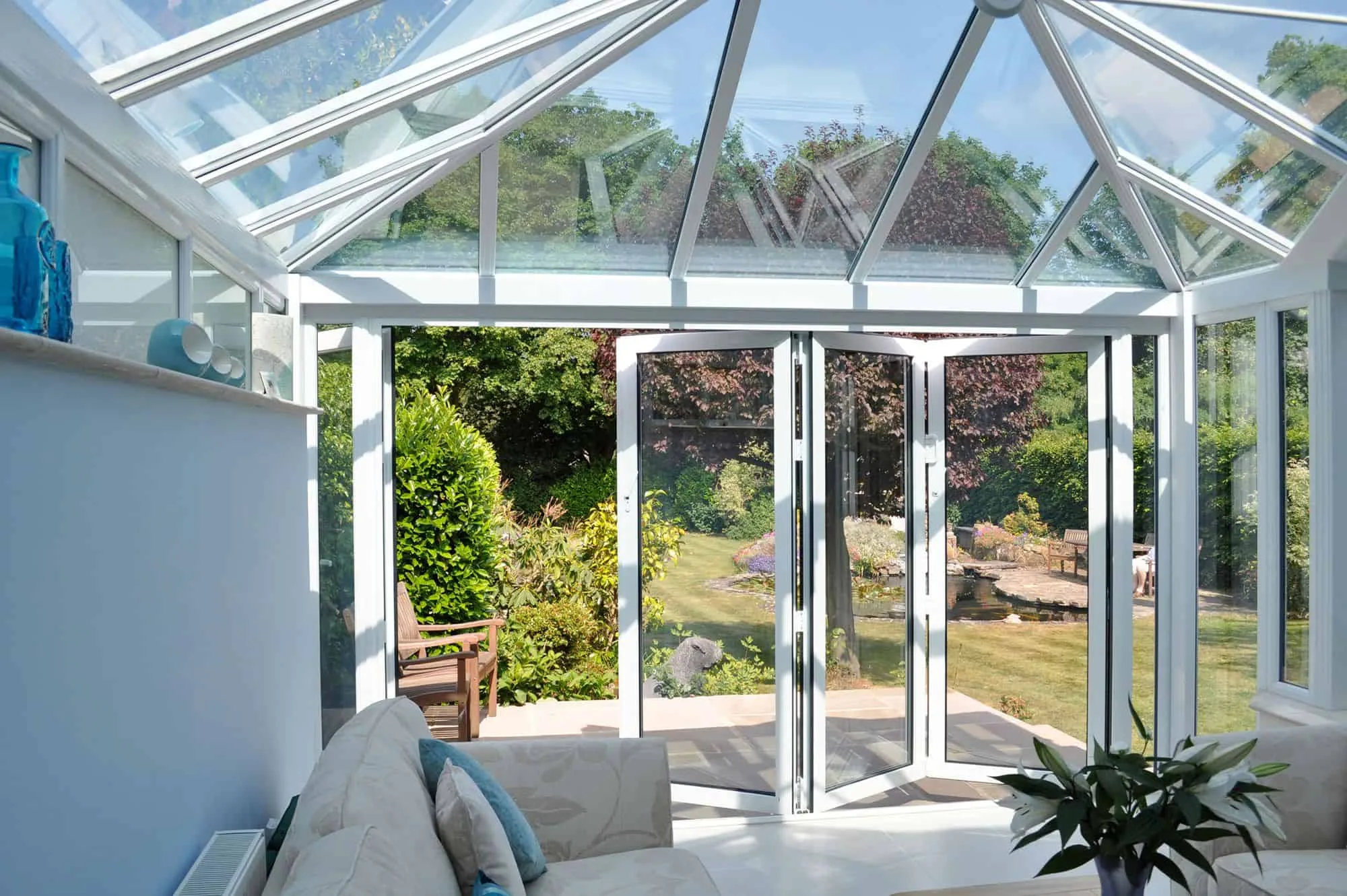
If you are looking to transform your conservatory into a comfortable, year-round living space, you’ve likely come across the term U-value. Put simply, a U-value measures thermal efficiency – how effective a building element is at preventing heat loss. The lower the U-value, the better the roof is at keeping heat inside during the winter and reflecting it away in the summer.
Under the strict UK Building Regulations (Part L: Conservation of Fuel and Power), replacement solid conservatory roofs are required to hit a target U-value of 0.15 W/m²K.
Many solid roof providers aggressively market that they hit this magic 0.15 figure. But here at Accolade Windows, we believe in complete transparency. Recent compliance data reveals a worrying trend in the home improvement industry: not all warm roof systems actually deliver on their thermal claims. Here is a look at the science behind the numbers, and why the Guardian Warm Roof remains the gold standard for your home.
The Reality Check: Flawed Spreadsheets vs. Real Science
In 2021, the methodology for calculating U-values was significantly tightened under a regulated standard known as BR443. To accurately test a roof structure today, technical teams must use highly advanced 3D thermal modeling software (called Trisco) handled by specialist structural engineers.
Unfortunately, many system manufacturers haven’t updated their practices. They are still relying on outdated spreadsheets and flawed calculations to claim their roofs achieve a 0.15 U-value.
Even worse, some point to Private Building Control approval as proof of compliance. However, investigations reveal that most private building control companies simply approve whatever paperwork a manufacturer hands them without validating the technical science behind it.
When competitor roof build-ups were accurately analysed using proper thermal modeling in line with modern BR443 standards, the results were eye-opening.
How Popular Competitors Fall Short
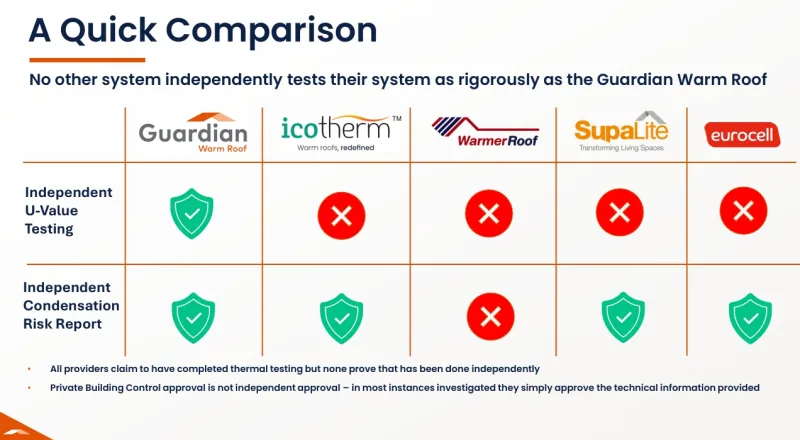
When subjected to rigorous, standardised thermal modeling, popular warm roof brands that claim a compliant 0.15 U-value actually failed to meet the mark, instead landing at a much less efficient 0.17 W/m²K:
- Icotherm Roofing Systems: Thermal modeling showed a U-value of 0.17 W/m²K. The core failure point was insulation depth – the roof structure simply isn’t deep enough to comply. Furthermore, the timber framing allows for cold bridging (where heat bypasses the insulation via the timber). When challenged directly on these findings, Icotherm declined to provide any independent technical evidence to support their 0.15 claim.
- Warmer Roof: Similarly failing to meet the standards, the Warmer Roof system registered at 0.17 W/m²K. Both the specific types of insulation utilised and the overall depth of the insulation layers were insufficient to satisfy modern building regulations. When asked to justify their claims, they also declined to provide further technical details.
- Eurocell Equinox: Despite defending their design, the Eurocell Equinox failed at 0.17 W/m²K. The structural issue here comes down to layout: 100mm of insulation is squeezed between the structural bars rather than running continuously under them, allowing severe cold bridging to occur. Additionally, the PIR insulation used features a poorer Lambda value (thermal conductivity) than premium alternatives. Eurocell confirmed no independent testing had ever been completed to verify their performance claims.
Other major brands like SupaLite also claim thermal compliance but lack verified, freely accessible independent testing to prove it.
Why Accolade Chooses the Guardian Warm Roof
We refuse to compromise on the comfort of your home or the compliance of your property. That is why at Accolade Windows, we proudly supply and install the Guardian Warm Roof.
Unlike its competitors, Guardian doesn’t ask you to take their word for it. They are the only provider that rigorously and continuously tests their systems independently with the BRE (Building Research Establishment) – the UK’s leading authority on building science.
The Guardian Difference:
- True 0.15 & 0.12 Performance: Guardian roofs are fully proven by the BRE to comfortably hit and surpass Part L building regulations.
- Engineered to Eliminate Cold Bridging: Rather than trapping insulation between structural elements, Guardian’s multi-layered rigid insulation configuration is engineered to block thermal leaks entirely.
- Independent Condensation Risk Reports: Guardian is completely certified against interstitial condensation, ensuring your structural timbers stay bone dry and protected for decades to come.
Peace of Mind for Your Home Investment
When you invest in a solid tiled conservatory roof, you are investing in lower energy bills, a quieter environment (reducing rain noise by up to 30 decibels), and a gorgeous extension-like space.
Don’t risk your investment or future home resale values on unverified manufacturer claims. Choose a system backed by real, independent scientific testing.
Ready to upgrade your living space with a genuine, high-performance Guardian Warm Roof?
Contact the expert team at Accolade Windows tod

- Why Is My Conservatory Too Hot in Summer? (And How to Fix It) - June 25, 2026
- The Truth About Warm Roof U-Values: Why Independent Testing Matters for Your Home Upgrade - May 22, 2026
- What Is The Best Style Of Window? - March 12, 2026
Latest News
Why Is My Conservatory Too Hot in Summer? (And How to Fix It)
What Is The Best Style Of Window?
The 4-Year Rule VS The New 10-Year Rule: Conservatory Planning in 2026
Salt Air & Windows: How to Choose Durable Frames for South West Coastal Homes
Instant Online Quote
Get a Free
Online Quote
Open and honest pricing for our full range of products
Start My Quote